Register now for Summer Professional Development.

Lesson Plan

Celebrating Differences

45 min

6-8

Lens/Domain

Anti-bias

Subject

Identity & Belonging

Topic

Inclusion

Overview

This lesson is meant to engage students in discussions to recognize and appreciate individual uniqueness.

Enduring Understandings

While people share many things in common, each individual’s identity is shaped by a distinct mix of culture, family, community, and personal experience. When we follow the same instructions, we do not always arrive at the same result — and that is not a problem to fix. Difference is information. Learning to see, name, and value what makes each person unique is the foundation of genuine inclusion and the first step toward understanding people whose lives look different from our own.

Essential Question

  • 1

    Why do people follow the same instructions differently, and what does that reveal about perspective?

  • 2

    What does it feel like to be “different,” and how does that feeling shape the way we treat others?

  • 3

    How do our individual identities —the things that make us each unique—connect us to, or separate us from, the people around us?

  • 4

    What does it mean to truly include someone, and how can knowing more about a person change the way we treat them?

Readiness

10 MIN

Explain to students that they will be asked to complete a number of tasks – you cannot answer any questions they have, but you can repeat the information. Students will likely ask questions such as, what way the paper should be folded, etc. Do not answer these questions. Ask that they do not talk during the activity.

Each student should have a blank piece of paper. Recite the following directions:

  1. Close your eyes- hold the piece of paper in your hands and listen and follow directions.
  2. Fold the paper in half.
  3. Fold the paper in half again.
  4. Tear off the bottom right corner of the paper.
  5. Turn the paper upside-down and tear off the bottom right corner.
  6. Keeping your eyes closed, open the paper up. Hold it over your head and open your eyes.
  7. Look around the room to see everyone’s paper.

Ask students:

  1. What did you find yourself looking for when you looked around the room?
  2. Did you look around to see if anyone else’s paper looked like yours? Why or why not?
  3. Did anyone feel like hiding their paper because it looked different from everyone else’s?
  4. Was there a “right” or “wrong” way to complete this task?
  5. What do you think the purpose of this activity was?

Explain to students that the purpose of this activity was:

  • To demonstrate that people frequently have different perspectives from one another and that there is not always any one “correct” perspective.
  • To illustrate how and why miscommunications can occur and provide an opportunity for participants to experience the human tendency to respond to feeling “different” by seeking out like-minded individuals.

Input

20 MIN

Everyone will receive the Find, Share, Connect worksheet. Once you have it, take a minute to read the page and mentally note which questions you can answer, but do not write on your own paper.

When I tell you to begin, circulate the room to find others who can respond to the questions in the squares. When you receive an answer from someone, ask them to sign that square on your paper. When a person signs your worksheet, ask them to share their response with you so you can learn more about them.

You should have as many peers as possible sign at least one square on the sheet. Depending on class size, the goal is to have no more than one square signed by a single person.

You will have 10 minutes to fill in as many squares as possible, with as many different people as you can.

Discussion Questions:

  • Which of the questions did you find most difficult?
  • How did it feel to ask people for information and to have other people ask you for information?
  • Did anything surprise you about this activity, either your own cultural knowledge or that of your peers?
  • Is there anything you learned from this activity which might encourage you and your peers to be welcoming to students who appear different in any way?

Output

15 MIN

Tell students that we’ve examined many ways we can be alike and different through today’s activities. Ask students to take a Post-it note and write a word that best describes how they most strongly identify themselves.

To respect everyone’s privacy, have them hand you the note and put it on the wall yourself. Once all the notes are up, invite students to take a moment to look around and read them.

Discussion Questions:

  • Raise your hand if you connected with anyone else’s response.
  • Was it easy or hard to determine what word you chose to self-identify?
  • Does knowing more about each other’s self-identities impact how we interact with each other?
  • Can you share ways in which knowing more about a peer could help you make them feel included during the school day?

Final Comments:

  • The purpose of today’s activities was to challenge each of us to recognize that while we may have things in common (live in the same city, attend the same school, might be the same age, etc.) we are also different in some ways.
  • Recognizing differences is one of many ways we can learn more about each other and from each other.

This lesson meets the following Academic Standards required by the Wisconsin Department of Public Instruction:

English Language Arts

SL.6.1 / SL.7.1 / SL.8.1 Engage effectively in a range of collaborative discussions with diverse partners, building on others’ ideas and expressing one’s own clearly.

Rationale: The lesson is built around reflection, guided discussion, and responding to ideas about identity and peoplehood.

L.6.6 / L.7.6 / L.8.6 Acquire and use grade-appropriate general academic and domain-specific words and phrases.

Rationale: Students are working with discipline-specific vocabulary, including identity, diversity, culture, traditions, community, and peoplehood.

W.6.2 / W.7.2 / W.8.2 Write informative/explanatory texts to examine a topic and convey ideas and information clearly.

Rationale: The iceberg worksheet and exit slip ask students to explain aspects of identity and reflect on understanding, though this is a lighter fit than speaking/listening. We suggest you attach this standard to this lesson only if you require students to write complete sentences, not single-word labels.

Summer Professional Development

July 7 & 8, 2026 – IN PERSON

Navigating the Holocaust

This workshop is a must-have for all new and current educators responsible for teaching about the Holocaust in their classrooms since Act 30 took effect. Hosted by the Nathan & Esther Pelz Holocaust Education Resource Center in partnership with the Wisconsin Department of Public Instruction.

Registration is open!

Classroom Experiences & Field Trips

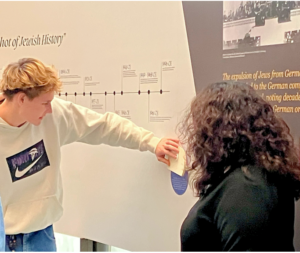
A high school student explores and interactive element on a timeline of Jewish history at JMM with the help of Chief Curator Molly Dubin.

Field Trips

As your one-stop concierge, J·Hub can help you schedule a variety of tours and workshops at Jewish Museum Milwaukee and beyond. Teachers report that their students develop a deeper understanding that carries back into the classroom. For more information on our tours and workshops, please follow this link.
Students from a local middle school pose with Holocaust survivor Edith Pump after listening to her testimony of her experiences.

Holocaust Survivor Testimony

Students bear witness to antisemitism through the accounts of Holocaust survivors and their descendants. Our Speakers Bureau members share personal histories, and when available, artifacts and photos to help students connect with history.
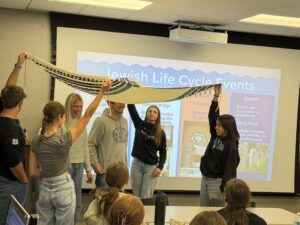
Spreading Jewish joy: High school students briefly enact what to expect at a Jewish wedding as they improvise a chuppah using a tallis (Jewish prayer shawl) during a peer led presentation from Student to Student presenters.

Student to Student

What is it like to be a Jewish teenager in 2026? In this student-led program (funded by the Irving L. Chortek Charitable Fund in Memory of Robert and Jennie Chortek) local Jewish teens visit your classroom to share personal stories and traditions. Students learn directly from peers, ask honest questions, and leave with a clearer understanding of Jewish identity and how to respond to bias.
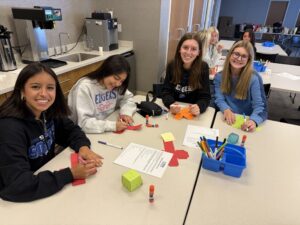
Students actively engage with an interactive workshop on Jewish identity at JMM.

Expert-Led Workshops

Our education team offers classroom-ready workshops for students and professional development sessions for teachers. Sessions are interactive, age-appropriate, and tailored to your goals, whether you want a strong introduction to Jewish identity, a deeper context for the Holocaust, or support in unpacking antisemitism.

Sign up for our newsletter

Stay connected with J·Hub. Get free, classroom-ready lesson plans, upcoming professional learning opportunities, and practical tools for supporting Jewish students, and strengthening inclusive school communities across Wisconsin.