
Wisconsin Academic Standards
This lesson meets the following Academic Standards required by the Wisconsin Department of Public Instruction:
Social Studies
Social Studies Inquiry Practices and Processes
SS.Inq1.a.m Formulate open-ended questions for further research within one or more social studies disciplines.
Rationale: The “I Notice / I Wonder” note-catcher asks students to generate genuine questions from what they observe in the footage, moving from observation to inquiry.
SS.Inq2.a.m Explore evidence from multiple reliable sources representing a range of perspectives and media that have been selected through research to guide the inquiry.
Rationale: Students engage with archival primary source footage from Yad Vashem as evidence, analyzing both its visual content and narration as distinct layers of a historical source.
Behavioral Sciences
SS.BH1.a.m Identify patterns such as culture, prior knowledge, family, peers, school, communities, and personal interests that influence a person’s identity and development.
Rationale: The lesson opens with a Quick Write asking “Who are you?” Students examine their own layered identity before connecting it to how Jewish identity in pre-war Europe was shaped by culture, tradition, community, and belonging.
SS.BH3.a.m Examine the role of culture, cultural diffusion, and cultural change on the development of societies and individuals.
Rationale: The Yad Vashem footage centers on Jewish music, celebrations, family life, and daily practice as evidence of a rich, diverse culture. Students analyze what that culture meant to the people who lived it.
History
SS.Hist2.a.m Analyze patterns of continuity and change over time and explain historical contexts that influenced those patterns.
SS.Hist4.a.m Evaluate a variety of primary and secondary sources to interpret historical context, intended audience, purpose, and/or author’s point of view.
Rationale: Students analyze the Yad Vashem footage as a primary historical source, attending to what the filmmakers chose to capture, how narration frames the images, and what that reveals about the intended audience and purpose.
English
Reading
R.6.6 / R.7.6 / R.8.6 (RI) Assess how point of view or purpose shapes the content and style of a text.
Rationale: Students watch the Yad Vashem footage first without sound, then with narration, and directly ask how the narration confirmed, contradicted, or expanded what they noticed visually. They are analyzing how perspective and framing shape the meaning of a source.
Writing
W.6.2 / W.7.2 / W.8.2 Write informative/explanatory texts to examine a topic and convey ideas and information clearly.
Rationale: Students write 4–6 sentences responding to the prompt “What surprised you about Jewish life before the Holocaust, and why is it important to study how people lived as well as how they died?” They must cite at least one specific detail from the video.
W.6.4 / W.7.4 / W.8.4 Produce clear and coherent writing in which the development, organization, and style are appropriate to the task, purpose, and audience.
Rationale: The quick write is tied to a specific purpose (honoring Jewish life, not only tragedy) and a specific audience (classroom discussion). Teacher modeling and timed writing support coherence and voice.
W.6.9 / W.7.9 / W.8.9 Draw evidence from informational texts to support analysis, reflection, and research.
Rationale: Students cite specific details from the Yad Vashem footage to support their written response about Jewish identity, resilience, and what was lost.
Speaking and Listening
SL.6.1 / SL.7.1 / SL.8.1 Engage effectively in a range of collaborative discussions with diverse partners, building on others’ ideas and expressing one’s own clearly.
Rationale: Students use Think–Ink–Pair–Share across all three video steps and in the Output, sharing responses with partners and the whole class. They identify and elevate a “powerful line” from their partner’s writing during the wrap-up.
SL.6.2 / SL.7.2 / SL.8.2 Interpret information presented in diverse media and formats and explain how it contributes to a topic, text, or issue.
Rationale: Students analyze archival footage of Jewish life in three structured viewing steps — first silently, then with narration. They record “I Notice / I Wonder” observations and track how the visual and audio layers together deepen understanding of Jewish daily life, community, and loss.
SL.6.4 / SL.7.4 / SL.8.4 Present claims and findings, sequencing ideas logically and using relevant descriptions, facts, and details.
Rationale: During the whole-class wrap-up, students share a “powerful line” from their partner’s writing and connect it to the Essential Questions about identity, resilience, and what the world lost. This requires presenting evidence and explaining its significance.
Related Lessons
Jewish Identity
Jewish Identity: Many Layers
In this lesson, students will explore what Judaism is, who the Jewish people are, and how identity can be noticeable, hidden, and shaped over time.
45 min
6-8

Classroom Experiences & Field Trips
Field Trips

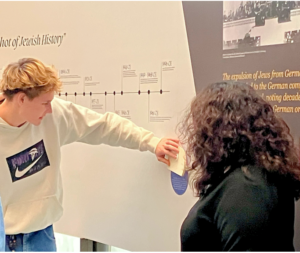
Holocaust Survivor Testimony
Students bear witness to antisemitism through the accounts of Holocaust survivors and their descendants. Our Speakers Bureau members share personal histories, and when available, artifacts and photos to help students connect with history.
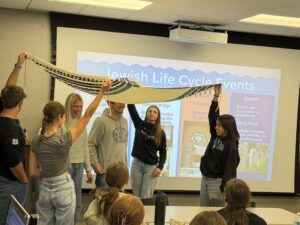
Student to Student
What is it like to be a Jewish teenager in 2026? In this student-led program (funded by the Irving L. Chortek Charitable Fund in Memory of Robert and Jennie Chortek) local Jewish teens visit your classroom to share personal stories and traditions. Students learn directly from peers, ask honest questions, and leave with a clearer understanding of Jewish identity and how to respond to bias.
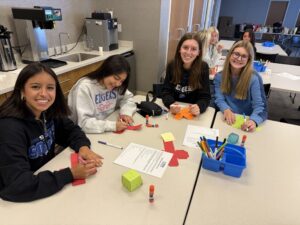
Expert-Led Workshops
Our education team offers classroom-ready workshops for students and professional development sessions for teachers. Sessions are interactive, age-appropriate, and tailored to your goals, whether you want a strong introduction to Jewish identity, a deeper context for the Holocaust, or support in unpacking antisemitism.
Sign up for our newsletter
Stay connected with J·Hub. Get free, classroom-ready lesson plans, upcoming professional learning opportunities, and practical tools for supporting Jewish students, and strengthening inclusive school communities across Wisconsin.