
Wisconsin Academic Standards
This lesson meets the following Academic Standards required by the Wisconsin Department of Public Instruction:
Social Studies
Social Studies Inquiry Practices and Processes
SS.Inq1.a.m Formulate open-ended questions for further research within one or more social studies disciplines.
Rationale: Students begin with identity reflection and prior knowledge, and the lesson’s discussion prompts ask them to generate and explore questions about how culture, community, and prejudice shaped Jewish life before WWII.
SS.Inq2.a.m Explore evidence from multiple reliable sources representing a range of perspectives and media that have been selected through research to guide the inquiry.
Rationale: Students read “A Picture of Jewish Life in Europe Before WWII” from Echoes & Reflections, a curated primary and secondary source text, and extract evidence into a four-quadrant organizer to guide discussion.
Behavioral Sciences
SS.BH1.a.m Identify patterns such as culture, prior knowledge, family, peers, school, communities, and personal interests that influence a person’s identity and development.
Rationale: The lesson is fundamentally about how identity is layered, shaped by community and context, and not always visible. Students examine their own identity before examining how Jewish identity in pre-war Europe was shaped by culture, tradition, modernization, and rising external pressure.
SS.BH3.a.m Examine the role of culture, cultural diffusion, and cultural change on the development of societies and individuals.
Rationale: Students analyze how Jewish communities adapted to modernization and nationalism while maintaining distinct cultural practices, and how that tension shaped both individual and communal identity.
History
SS.Hist2.a.m Analyze patterns of continuity and change over time and explain historical contexts that influenced those patterns.
Rationale: Students trace how Jewish life in Europe shifted across the late 19th and early 20th centuries in response to modernization, nationalism, and rising antisemitism, identifying both what changed and what communities worked to preserve.
SS.Hist3.a.m Connect past events, people, and ideas to the present and use different perspectives to draw conclusions.
Rationale: The wrap-up discussion asks students to connect the historical experience of Jewish communities in pre-war Europe to Essential Questions about identity, belonging, and the impact of prejudice, drawing explicit bridges between past and present.
English Language Arts
Reading
R.6.1 / R.7.1 / R.8.1 (RI) Cite textual evidence to support analysis of what the text says explicitly and implicitly, and make logical inferences.
Rationale: Students read “A Picture of Jewish Life in Europe Before WWII” and pull specific details into the four-quadrant organizer, then use those details in the whole-class discussion about culture, modernization, antisemitism, and Jewish responses.
R.6.2 / R.7.2 / R.8.2 (RI) Determine central ideas of an informational text and summarize them objectively.
Rationale: Students identify main ideas for each section of the reading and write a six-word summary in the center of the organizer that captures Jewish life in Europe between the wars.
R.6.3 / R.7.3 / R.8.3 (RI) Analyze how individuals, events, and ideas are introduced, related to each other, and developed.
Rationale: Students track how modernization, nationalism, and antisemitism affected Jewish daily life and how different Jewish communities responded, including debate about assimilation and Zionism.
Speaking and Listening
SL.6.1 / SL.7.1 / SL. 8.1 Engage effectively in a range of collaborative discussions with diverse partners, building on others’ ideas and expressing one’s own clearly.
Rationale: Students use Think–Pair–Share, Think–Ink–Pair–Share, and whole-class discussion to explore identity, belonging, and Jewish life before the Holocaust. They draw on their organizer notes as evidence during discussion.

Classroom Experiences & Field Trips
Field Trips

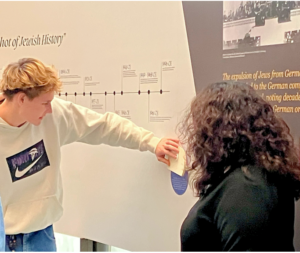
Holocaust Survivor Testimony
Students bear witness to antisemitism through the accounts of Holocaust survivors and their descendants. Our Speakers Bureau members share personal histories, and when available, artifacts and photos to help students connect with history.
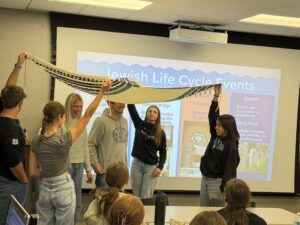
Student to Student
What is it like to be a Jewish teenager in 2026? In this student-led program (funded by the Irving L. Chortek Charitable Fund in Memory of Robert and Jennie Chortek) local Jewish teens visit your classroom to share personal stories and traditions. Students learn directly from peers, ask honest questions, and leave with a clearer understanding of Jewish identity and how to respond to bias.
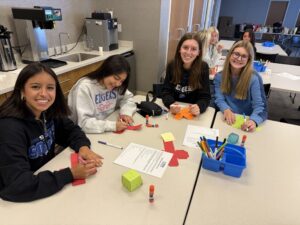
Expert-Led Workshops
Our education team offers classroom-ready workshops for students and professional development sessions for teachers. Sessions are interactive, age-appropriate, and tailored to your goals, whether you want a strong introduction to Jewish identity, a deeper context for the Holocaust, or support in unpacking antisemitism.
Sign up for our newsletter
Stay connected with J·Hub. Get free, classroom-ready lesson plans, upcoming professional learning opportunities, and practical tools for supporting Jewish students, and strengthening inclusive school communities across Wisconsin.