Register now for Summer Professional Development.

Lesson Plan

Golda Meir’s Leadership

50 MIN

6-8

Lens/Domain

Israel

Subject

Jewish American History

Topic

Golda Meir

Overview

In this lesson, students explore Golda Meir’s background, values, and leadership, tracing how an immigrant child in Milwaukee grew to be the first female prime minister of Israel and a global leader. They analyze how leadership can take root in everyday communities, then apply those insights to their own lives by creating comic strips.

Jewish Museum Milwaukee logo

This lesson plan utilizes a video from PBS Kids and was created using resources from the archives of Jewish Museum Milwaukee.

Enduring Understandings

  • Leadership grows from everyday experiences, identity, and community, which means it can begin anywhere, with anyone.
  • Jewish heritage and history demonstrate resilience through migration, community-building, and civic contributions.
  • Where leaders come from, and who they are, shape how they understand responsibility.

Essential Question

  • 1

    Are leaders shaped more by their circumstances or by their choices?

  • 2

    Does belonging to a community come with obligations?

  • 3

    How do communities shape their leaders, and how do leaders shape their communities?

Readiness

15 MIN


Partner Discussion

Open with a partner discussion. Pose this question to the class and direct them to turn and talk:

  • “What values make someone a good leader?”

Give pairs 1 to 2 minutes. Then call on one person from each pair to share a value or two, and record their answers on the board or chart paper.

Introduce Golda Meir

Say:

  • “Today we’ll learn about Golda Meir, a leader who faced many difficult decisions. She grew up in Milwaukee after her Jewish family immigrated from Kyiv to escape antisemitism and violence in Eastern Europe. Like many Jewish communities at the time, her family valued education, helping others, and working together. These values helped shape her leadership later in life, first in Milwaukee and eventually in Israel, where she became one of the country’s founders and its fourth Prime Minister. Golda was the third woman in history to become the head of state for a country.”

Video Clip

Show timestamps 5:19–11:50 from Xavier Riddle and the Secret Museum to introduce Golda Meir’s story.

After the clip, ask:

  • “What experiences shaped Golda’s beliefs and values?”
  • “What motivated her life choices?”
  • “What challenges did she face in pursuing her goals?”
  • “Golda left a comfortable life in Milwaukee to help build a new country, Israel. What would make someone take that kind of risk?”
  • “How did she balance personal life with her ambitions?”
  • “What qualities helped her become a leader?”
  • “How might her early life and identity have prepared her for future leadership?”

Input

15 MIN

Teacher’s Note

Answer Key: Order: G L E K D B F C J A I H; 1. G – First photo (1904); 2. L – Milwaukee Journal, textbook drive; 3. E – 8th grade, 4th Street School (1912); 4. K – Normal School, class officer (1916–17); 5. D – Poale Zion pageant (1919); 6. B – Moves to Israel (1921); 7. F – Political career; signs Israel’s Declaration of Independence (1948); 8. C – Meets JFK (1962); 9. J – Elected Prime Minister (1969); 10. A – Returns to Milwaukee (1969); 11. I – New York speech (1972); 12. H – Dies (1978).

Timeline Activity (10 minutes)

Divide students into small groups of three or four. Explain that this task has two parts: matching and ordering.

PART 1Match the Event to the Photo

  • Use the provided set of archival images and compare them to the events from Golda Meir’s life.
  • Carefully look at each photo: What do you notice? (clothing, setting, people, age, location clues) What time period might it be from?
  • Match each photo to the event you think it represents.

PART 2Put the Events in Order

  • Once all the photos and events are matched, students work with their group to place them in chronological order, earliest to latest.
  • Groups lay their cards out on the table in order.

Materials: Printed timeline cards (events from Golda Meir’s life). Be sure to print all pages of the file, as the first page includes instructions and the final page includes individual events, which will need to be cut into slips.

Once groups complete their timeline, review it together as a class to clarify the actual order: G, L, E, K, D, B, F, C, J, A, I, H.

Discussion (5 minutes)

Ask students the following questions:

  • “What challenges did Golda face at different points in her life?”
  • “How might her experiences as a Jewish immigrant have shaped her understanding of leadership?”
  • “How might belonging to a community influence someone’s sense of responsibility?”

Reinforce and underscore answers that relate to:

  • Making difficult decisions
  • Feeling responsible for your community
  • Balancing different perspectives
  • Responding to uncertainty

Then say:

  • “Historical leaders are often complex figures. They can be important and influential while still making decisions that people debate or question. The goal of studying Golda’s leadership is to understand how people respond to difficult circumstances.”

Output

15 MIN

After learning about leadership through the life of Golda Meir, students will apply those ideas to a real situation in their own lives. A Community Leadership Comic Strip allows students to organize their thinking visually while focusing on leadership qualities, problem-solving, and responsible actions.

Planning (5 minutes)

Provide students with the “Comic Strip Planning Worksheet.” Explain that Golda Meir noticed issues in her community and needed to use her values and leadership skills to address them. Tell students that today, they will be envisioning themselves doing the same. Explain that the questions on the worksheet will help them create a plan before they illustrate it in a comic strip.

Creating the Comic Strip (10 minutes)

Provide students with the template from the Comic Strip Planning Materials. Students may include:

  • Drawings
  • Symbols
  • Arrows showing connections
  • Speech bubbles
  • Keywords and captions

Exit Ticket (Optional)

3-5 MIN

When the class is back together, ask students to write down an answer to one of the following questions:

  • “The leadership quality I think is most important is…”
  • “One thing leaders must do when solving problems is…”

Teacher Tips

Local roots: Golda Meir grew up in Milwaukee, but her leadership decisions eventually affected people around the world, as one of Israel’s founders and its 4th prime minister. Remind students that her story shows how leadership often begins with everyday experiences and grows over time.
Frame leadership as using your values and identity to guide your decisions and taking responsibility when challenges arise.
Historical context matters: Golda’s leadership occurred during complicated political and historical circumstances, including wars and national debates.
Prep shortcut: if you do not have time to cut the timeline events into strips beforehand, build in extra time for students to do it during the activity.
Comic strip focus: remind students the strip should show a leadership choice and its effect: problem, values, action, outcome. That structure lets the art carry analysis and hit both the Art communication standard and the Social Studies civic-responsibility goal.
If controversy arises, emphasize that studying leaders does not require students to agree with every decision they make. The focus is on understanding leadership challenges and historical context.

This lesson meets the following Academic Standards required by the Wisconsin Department of Public Instruction:

Social Studies

SS.Inq2.a.m:

Explore evidence from multiple reliable sources representing a range of perspectives and media, selected through research to guide the inquiry.

Rationale: The timeline activity has students examine archival photographs as primary sources, reading each for clues before matching and ordering them.

SS.Hist1.a.m:

Use multiple perspectives to analyze and explain the causes of issues or events within and across time periods.

Rationale: The video and discussion ask students to trace what experiences and historical conditions shaped Golda’s values and leadership.

SS.BH1.a.m:

Identify patterns such as culture, family, community, and personal interests that influence a person’s perceptions and behavior.

Rationale: The lesson centers on how her Jewish immigrant upbringing and community shaped her sense of responsibility and leadership.

SS.Inq5.a.m:

Explore opportunities for personal or group civic engagement with community, state, national, and global implications.

Rationale: The Community Leadership Comic Strip asks students to envision their own leadership and civic action, applying Golda’s example to their own lives.

English Language Arts

SL.6.1 / SL.7.1 / SL.8.1 Engage effectively in a range of group discussions with diverse partners, building on others’ ideas and expressing one’s own clearly.

Rationale: The lesson runs on discussion, from the opening turn-and-talk about leadership values through small-group timeline work, whole-class debrief, and the exit ticket share.

SL.6.2 / SL.7.2 / SL.8.2 Analyze the purpose of information presented in diverse media and formats.

Rationale: Students draw meaning from the Xavier Riddle video clip to understand Golda’s early life and choices.

W.6.3 / W.7.3 / W.8.3 Write narratives to develop real or imagined experiences or events with clear sequencing and detail.

Rationale: The comic strip is a visual narrative based on a planned leadership scenario, featuring captions and dialogue. The exit ticket adds a light writing moment; attach a writing standard to it only if you require full-sentence responses rather than sentence-stem completions.

L.6.6 / L.7.6 / L.8.6 Acquire and use grade-appropriate general academic and domain-specific words and phrases.

Rationale: Students work with vocabulary such as leadership, values, immigrant, community, and civic contribution across the discussion and output.

Art & Design

A.A.Cr.8.m Generate original solutions through exploration and practice. Rationale: The Comic Strip Planning Worksheet has students devise an original response to a community problem before drawing.

A.A.Cr.9.m Engage in experimentation with the expressive qualities of media, tools, and techniques with refined craftsmanship. Rationale: Students build the comic using drawings, symbols, arrows, speech bubbles, and captions to carry meaning.

Rationale: The lesson runs on discussion, from the opening turn-and-talk about leadership values through small-group timeline work, whole-class debrief, and the exit ticket share.

SL.6.2 / SL.7.2 / SL.8.2 Analyze the purpose of information presented in diverse media and formats.

Rationale: Students draw meaning from the Xavier Riddle video clip to understand Golda’s early life and choices.

W.6.3 / W.7.3 / W.8.3 Write narratives to develop real or imagined experiences or events with clear sequencing and detail.

Rationale: The comic strip is a visual narrative based on a planned leadership scenario, featuring captions and dialogue. The exit ticket adds a light writing moment; attach a writing standard to it only if you require full-sentence responses rather than sentence-stem completions.

L.6.6 / L.7.6 / L.8.6 Acquire and use grade-appropriate general academic and domain-specific words and phrases.

Rationale: Students work with vocabulary such as leadership, values, immigrant, community, and civic contribution across the discussion and output.

Summer Professional Development

July 7 & 8, 2026 – IN PERSON

Navigating the Holocaust

This workshop is a must-have for all new and current educators responsible for teaching about the Holocaust in their classrooms since Act 30 took effect. Hosted by the Nathan & Esther Pelz Holocaust Education Resource Center in partnership with the Wisconsin Department of Public Instruction.

Registration is open!

Classroom Experiences & Field Trips

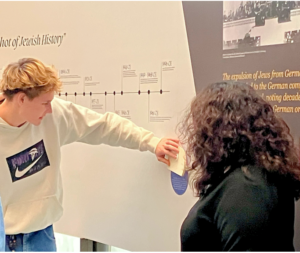
A high school student explores and interactive element on a timeline of Jewish history at JMM with the help of Chief Curator Molly Dubin.

Field Trips

As your one-stop concierge, J·Hub can help you schedule a variety of tours and workshops at Jewish Museum Milwaukee and beyond. Teachers report that their students develop a deeper understanding that carries back into the classroom. For more information on our tours and workshops, please follow this link.
Students from a local middle school pose with Holocaust survivor Edith Pump after listening to her testimony of her experiences.

Holocaust Survivor Testimony

Students bear witness to antisemitism through the accounts of Holocaust survivors and their descendants. Our Speakers Bureau members share personal histories, and when available, artifacts and photos to help students connect with history.
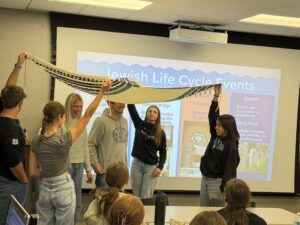
Spreading Jewish joy: High school students briefly enact what to expect at a Jewish wedding as they improvise a chuppah using a tallis (Jewish prayer shawl) during a peer led presentation from Student to Student presenters.

Student to Student

What is it like to be a Jewish teenager in 2026? In this student-led program (funded by the Irving L. Chortek Charitable Fund in Memory of Robert and Jennie Chortek) local Jewish teens visit your classroom to share personal stories and traditions. Students learn directly from peers, ask honest questions, and leave with a clearer understanding of Jewish identity and how to respond to bias.
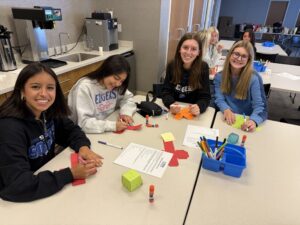
Students actively engage with an interactive workshop on Jewish identity at JMM.

Expert-Led Workshops

Our education team offers classroom-ready workshops for students and professional development sessions for teachers. Sessions are interactive, age-appropriate, and tailored to your goals, whether you want a strong introduction to Jewish identity, a deeper context for the Holocaust, or support in unpacking antisemitism.

Sign up for our newsletter

Stay connected with J·Hub. Get free, classroom-ready lesson plans, upcoming professional learning opportunities, and practical tools for supporting Jewish students, and strengthening inclusive school communities across Wisconsin.