Register now for Summer Professional Development.

Lesson Plan

Jewish American Heritage Month

45 min

6-8

Lens/Domain

Jewish American History

Subject

Jewish Identity & Peoplehood

Topic

Jewish American Contributions

Overview

This lesson plan utilizes several resources from the Institute for Curriculum Services lesson plan titled “Jewish Americans: Identity, History, and Experience.” It can be used to introduce your students to Jewish American Heritage Month in May.

Jewish Museum Milwaukee logo
48 Jews: Layers of Identity Exhibition

This lesson is inspired by the 48 Jews: Layers of Identity Exhibition curated by Molly Dubin at Jewish Museum Milwaukee. Tours and field trips are still available for the summer months.

Enduring Understanding

Jewish Americans are a people, not only a religious group. For thousands of years, Jewish identity has been shaped by shared history, culture, language, and resilience across generations and continents. Celebrating Jewish American Heritage Month means recognizing the depth and diversity of that identity and the lasting contributions Jewish Americans have made to the United States.

Essential Question

  • 1

    How does celebrating Jewish American Heritage Month contribute to a deeper understanding of American history and a more inclusive society?

  • 2

    How can we use the knowledge gained from celebrating Jewish American Heritage Month to create a more inclusive and respectful learning environment for all students?

  • 3

    What does it mean to belong to a people — and how does understanding Jewish peoplehood change the way we understand Jewish American history?

Readiness

Explain to students that in the United States, we dedicate specific months of the year to recognizing and celebrating the diverse cultures and histories of various ethnic and marginalized groups. These heritage months aren’t just about holidays or specific events, rather they’re a chance to delve deeper into the stories and contributions of these groups to American history and culture. They offer a focused spotlight on the richness and complexity of our nation’s past, present, and future.

These celebrations offer more than just historical facts. They provide valuable opportunities to explore our unique identities and cultural backgrounds and to learn about and appreciate the experiences of others.

Explain that this lesson will focus on one of those unique heritages and histories -Jewish Americans.

The United States Department of State explains,

“In 2006, President George W. Bush declared May Jewish American Heritage Month to celebrate and recognize the millions of Jewish people who call the United States home. America has long been a safe haven for religious diversity, where members of any faith can freely practice their religion. A significant number of Jewish Americans are the descendants of Jews who fled not only discrimination and persecution but also, in the case of many European Jews, genocide at the hands of the Nazis and their allies in the 1930s and 1940s. Notwithstanding shameful resistance to Jewish immigration during World War II by personnel at the Department of State and other parts of the U.S. government, America became a refuge for millions of Jews and is now home to approximately one-third of the world’s Jewish people. Each May, we pay tribute to the many contributions Jewish Americans have made, and continue to make, to the United States, including Supreme Court Justices and Nobel Prize winners. As the world witnesses a rise in global antisemitism, the United States stands with the diverse American Jewish community and celebrates its rich and varied cultures and long history.”

Input

20 MIN

To celebrate Jewish American Heritage Month, it is important to understand the concept of Jewish peoplehood.

Begin by explaining to students that while Judaism is a religion, Jews are not only a religious group. They are also an ethnicity and a people. The concept of Jewish peoplehood means that Jews share a sense of collective identity and belonging like a big, extended family with a long and complex history. The peoplehood is built on shared historical experiences, values, traditions, and a connection to their ancestral homeland, Israel. For thousands of years, Jews have maintained a sense of unity through their culture, language (Hebrew), and a shared narrative that includes both triumphs and struggles. This sense of peoplehood is a core part of what it means to be Jewish, connecting individuals across the globe and through generations.

Next, show this video and have the students jot down key takeaways as they are watching. Provide students with the following resources from the Institute for Curriculum Services (ICS) that they can review, highlight, or jot down information that stands out to them.

Output

Using the information they learned from the video and the fact sheets, students, either independently or in small groups, should create a flier (handmade or digital) to promote the celebration of Jewish American Heritage Month.

The flier should include:

  • A creative title that signifies the celebration of Jewish American Heritage Month (JAHM)
  • A short explanation about when JAHM is and the significance of the month (when it began, why it was created, etc.)
  • Brief but informative text that highlights key aspects of your learning about Jewish peoplehood that would excite other schools to celebrate JAHM.
  • Consider things like:
    • Images, illustrations, or symbols that represent what was learned about Jewish peoplehood from the video and fact sheets
    • A key Jewish American and their impact
    • An important contribution made by Jewish Americans to society
    • One or more cultural/religious traditions, practices, or beliefs

You may use this rubric to score the flyers.

Teacher Tips

On Teaching Jewish Peoplehood

Students may enter this lesson with the assumption that Judaism is only a religion, similar to Christianity or Islam. The peoplehood framing is genuinely different from what many students have encountered, and it is worth spending a moment letting them sit with that complexity before moving on. Avoid flattening it: Jews are not a race, not only a religion, and not a monolith. The diversity within Jewish American life is part of the lesson’s point.

On the ICS Resources

Preview all three fact sheets before the lesson. The Jewish American Diversity Fact Sheet in particular surfaces geographic, ethnic, and cultural diversity within Jewish communities that students may find surprising — Sephardic, Ashkenazi, Mizrahi, Ethiopian, and other Jewish communities are all represented. That diversity is worth naming explicitly rather than letting students assume “Jewish American” means one thing.

On the Flier Output

Give students a few minutes to review the rubric before they begin creating. The Jewish Peoplehood & Celebration category carries the most weight (30%) and is the most conceptually demanding — students need to go beyond listing facts about holidays and connect to the idea of shared identity across generations and continents. If students are working in groups, consider assigning roles so that research, writing, and visual design are distributed intentionally.

On Sensitive Conversations

The Department of State excerpt references both the Holocaust and present-day antisemitism. Students may have questions or reactions that extend beyond the lesson’s scope. It is appropriate to acknowledge those briefly and return focus to the affirmative goal of the lesson: celebrating Jewish American life and contributions, not only Jewish suffering or threat.

This lesson meets the following Academic Standards required by the Wisconsin Department of Public Instruction:

English Language Arts

Reading
R.6.2 / R.7.2 / R.8.2 (RI) Determine central ideas of an informational text and summarize them objectively.

Rationale: Students read and annotate three ICS fact sheets and watch a video, identifying key ideas about Jewish peoplehood, Jewish American diversity, and Jewish American contributions to carry into their flier.


R.6.3 / R.7.3 / R.8.3 (RI) Analyze how individuals, events, and ideas are introduced, related to each other, and developed.

Rationale: Students synthesize information across multiple sources — video, fact sheets, and the Department of State text tracking how Jewish identity, history, and contribution are connected across time and context.


Writing
W.6.2 / W.7.2 / W.8.2 Write informative/explanatory texts to examine a topic and convey ideas and information clearly.

Rationale: The flier asks students to explain what Jewish American Heritage Month is, why it matters, and what
Jewish peoplehood means—all of which require clear, accurate, audience-aware informational writing.


W.6.4 / W.7.4 / W.8.4 Produce clear and coherent writing in which the development, organization, and style are appropriate to task, purpose, and audience.

Rationale: The flier is a real-world writing genre with a specific
purpose (celebrating JAHM) and a specific audience (other schools and students). Students must make deliberate choices about tone, layout, and content to meet that purpose effectively.

W.6.6 / W.7.6 / W.8.6 Use technology, including the internet, to produce and publish writing and to interact with and present information.

Rationale: Students may create their flier digitally using design tools or word processing software, applying writing and design skills to produce a shareable, publication-ready product.


Speaking and Listening
SL.6.1 / SL.7.1 / SL.8.1 Engage effectively in a range of collaborative discussions with diverse partners, building on others’ ideas and expressing one’s own clearly.

Rationale: Students discuss key takeaways from the video and fact sheets before beginning the flier, and those working in small groups must make shared decisions about content, emphasis, and design.


Language
L.6.6 / L.7.6 / L.8.6 Acquire and use grade-appropriate general academic and domain-specific words and phrases.

Rationale: Students engage with vocabulary central to this lesson: peoplehood, heritage, diaspora, identity, antisemitism, and contributions. The flier requires them

Summer Professional Development

July 7 & 8, 2026 – IN PERSON

Navigating the Holocaust

This workshop is a must-have for all new and current educators responsible for teaching about the Holocaust in their classrooms since Act 30 took effect. Hosted by the Nathan & Esther Pelz Holocaust Education Resource Center in partnership with the Wisconsin Department of Public Instruction.

Registration is open!

Classroom Experiences & Field Trips

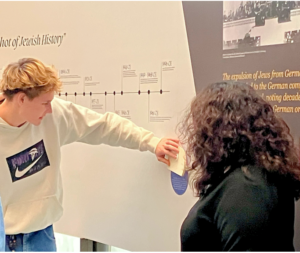
A high school student explores and interactive element on a timeline of Jewish history at JMM with the help of Chief Curator Molly Dubin.

Field Trips

As your one-stop concierge, J·Hub can help you schedule a variety of tours and workshops at Jewish Museum Milwaukee and beyond. Teachers report that their students develop a deeper understanding that carries back into the classroom. For more information on our tours and workshops, please follow this link.
Students from a local middle school pose with Holocaust survivor Edith Pump after listening to her testimony of her experiences.

Holocaust Survivor Testimony

Students bear witness to antisemitism through the accounts of Holocaust survivors and their descendants. Our Speakers Bureau members share personal histories, and when available, artifacts and photos to help students connect with history.
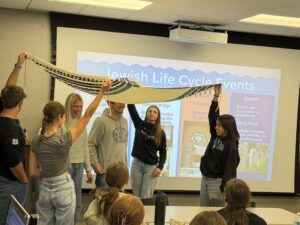
Spreading Jewish joy: High school students briefly enact what to expect at a Jewish wedding as they improvise a chuppah using a tallis (Jewish prayer shawl) during a peer led presentation from Student to Student presenters.

Student to Student

What is it like to be a Jewish teenager in 2026? In this student-led program (funded by the Irving L. Chortek Charitable Fund in Memory of Robert and Jennie Chortek) local Jewish teens visit your classroom to share personal stories and traditions. Students learn directly from peers, ask honest questions, and leave with a clearer understanding of Jewish identity and how to respond to bias.
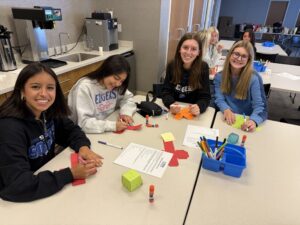
Students actively engage with an interactive workshop on Jewish identity at JMM.

Expert-Led Workshops

Our education team offers classroom-ready workshops for students and professional development sessions for teachers. Sessions are interactive, age-appropriate, and tailored to your goals, whether you want a strong introduction to Jewish identity, a deeper context for the Holocaust, or support in unpacking antisemitism.

Sign up for our newsletter

Stay connected with J·Hub. Get free, classroom-ready lesson plans, upcoming professional learning opportunities, and practical tools for supporting Jewish students, and strengthening inclusive school communities across Wisconsin.